
Quiff hairstyles are bold, confident, and effortlessly stylish. These 41 quiff hairstyles range from timeless classics to modern faded and textured versions, giving you height, shape, and a sharp finish that works for everyday life and special occasions alike.
1. Classic Quiff
The classic quiff is the timeless original that made this cut famous: hair swept up and back from the forehead into a smooth, rounded wave, with neatly tapered sides that keep the focus on the height at the front. Its appearance is polished and masculine, with a clean silhouette, a soft natural shine, and a front section that rises gently rather than standing straight up. The finish looks groomed without looking stiff, which is why it works just as well in an office as it does on a night out, and why it has survived decades of changing trends. From the side, the profile is clean and balanced, with the height at the front tapering smoothly into the crown so there is no abrupt step or bulky ridge. The back is kept tidy and blended, which means the cut looks just as good from behind as it does from the front. It can be worn slightly higher for evenings or flattened a touch for conservative workplaces, and a small change in product shine completely changes its mood.
This version suits most face shapes, especially oval, square, and oblong faces, and it works best on straight to slightly wavy hair of medium thickness. Men with very curly or very fine hair can still wear it, but they will need extra control from the right product and a careful blow-dry. To style, apply a volumising mousse or light pomade to damp hair, blow-dry the front upward and back with a round brush, and finish with a medium-hold pomade combed into place. A trim every four weeks keeps the taper neat and the front at the right length. Choose the classic quiff when you want a proven, versatile style that looks sharp, confident, and never dated. Ask your barber to show you the blow-drying direction during your appointment, because getting the front to lift at the roots is the skill that makes this cut work at home. Use only a fingertip-sized amount of product at first, since too much will weigh the front down and make it look greasy by midday. If your hair falls flat in humidity, a light pre-styling spray applied before blow-drying will give the roots extra grip and help the shape survive the whole day.

2. Textured Quiff
The textured quiff trades smooth polish for modern, piecey movement: the front is cut with point-cutting techniques so it breaks into separate, touchable strands instead of falling as one solid wave. Its appearance is relaxed and contemporary, with visible separation through the top, a matte finish, and a front that looks deliberately tousled rather than perfectly combed. This texture gives the cut energy and depth, making it look thicker and more interesting from every angle, and it photographs beautifully because the hair catches light in different directions. The separation also means the cut looks good as it grows, because longer pieces simply fall into new, interesting positions rather than forming a solid helmet shape. Viewed from above, the top has visible dimension and shadow, which is why it photographs so well and looks thicker in real life than a smooth style would. It can be pushed forward for a casual fringe effect or swept back for a smarter finish, giving you two looks from one cut.
Textured quiffs suit oval, round, and heart-shaped faces particularly well, since the broken-up front softens the forehead and adds height without bulk. They work on straight, wavy, and even slightly curly hair, and they are a great choice for men whose hair is medium to thick. To style, work a matte clay or paste through damp hair, blow-dry the front upward while scrunching and twisting small sections with your fingers, and finish by pinching pieces apart. A trim every three to four weeks keeps the texture intentional rather than overgrown. Choose the textured quiff when you want a current, low-fuss style with plenty of personality. When you visit the barber, ask for point cutting through the top and a textured finish rather than blunt ends, because that is what creates the piecey separation. Avoid heavy waxes that clump the pieces together, and instead choose a dry clay that keeps strands separate and touchable. On second-day hair, a quick refresh with dry shampoo at the roots restores lift without a full wash, making this an excellent choice for busy mornings.

3. Modern Quiff
The modern quiff is a sharper, cleaner update on the classic: the sides are tapered close but not shaved bare, the top is left long enough for real height, and the front is brushed up with a soft, controlled wave. Its appearance is sleek and current, with a tidy outline, a natural-looking lift at the forehead, and a finish that sits somewhere between polished and relaxed. It is the quiff most men actually want day to day, because it looks intentional without demanding a long styling routine or a shelf full of products. The outline is deliberately tidy, with the hairline and sideburns cleaned up so the whole cut frames the face neatly. Unlike more extreme faded versions, the sides retain enough length to look soft and natural, which means the style grows out gracefully and never looks harsh between appointments. It also adapts well to different outfits, looking equally at home with a suit, a leather jacket, or a simple t-shirt and jeans.
This cut flatters oval, square, and diamond face shapes and suits straight or wavy hair of medium density best, though thick hair can carry it with some thinning at the top. To style, apply a pea-sized amount of medium-hold cream to damp hair, blow-dry forward and then up using your fingers or a vent brush, and set the front with a light mist of flexible hairspray. A trim every four weeks maintains the taper and keeps the top from getting heavy. Choose the modern quiff when you want a versatile, office-friendly style that still turns heads at the weekend. Your barber should cut the top with enough length to brush up but not so much that it flops forward by lunchtime, so bring a photo showing the exact height you prefer. Blow-drying with your head tilted slightly forward helps the roots stand up, and finishing with your fingers rather than a comb keeps the result looking natural. If you exercise regularly, a sweat-resistant matte paste will hold the shape better than a cream.

4. Short Quiff
The short quiff keeps all the attitude of the style in a compact, easy-to-manage package: the front is only a few inches long, lifted just enough to create a clear quiff shape, while the sides are kept short and tidy. Its appearance is crisp and athletic, with a clean profile, minimal bulk, and a front that reads as a deliberate sweep rather than a full wave. Because there is less length to control, it holds its shape through long days, workouts, and windy weather far better than longer versions, making it a practical choice for active men. The compact length also means the cut is very forgiving of cowlicks and awkward growth patterns, because there is simply less hair to misbehave. From behind, the short back and sides give a clean, athletic silhouette that suits sporty and professional lifestyles alike. It is also an excellent transitional cut, allowing you to grow into a longer quiff later or keep it short permanently without ever looking unfinished.
Short quiffs suit almost every face shape, including round faces that can be overwhelmed by very tall styles, and they work well on straight, wavy, and thick hair. Fine hair also benefits, because the shorter front is lighter and easier to lift. To style, apply a small amount of matte paste to towel-dried hair, blow-dry the front up and slightly back for ten seconds, and shape it with your fingers. A trim every three weeks keeps the short shape sharp, and grow-out simply becomes a medium quiff. Choose the short quiff when you want maximum impact with minimum morning effort. Because the styling takes less than two minutes, this is the quiff to choose if you dislike long morning routines or frequently rush out of the door. A single small scoop of paste is enough, and over-applying product is the most common mistake, since it makes short hair look sticky rather than textured. Wash every other day if your scalp allows, because slightly lived-in hair often holds a short quiff better than freshly washed, slippery hair.

5. Long Quiff
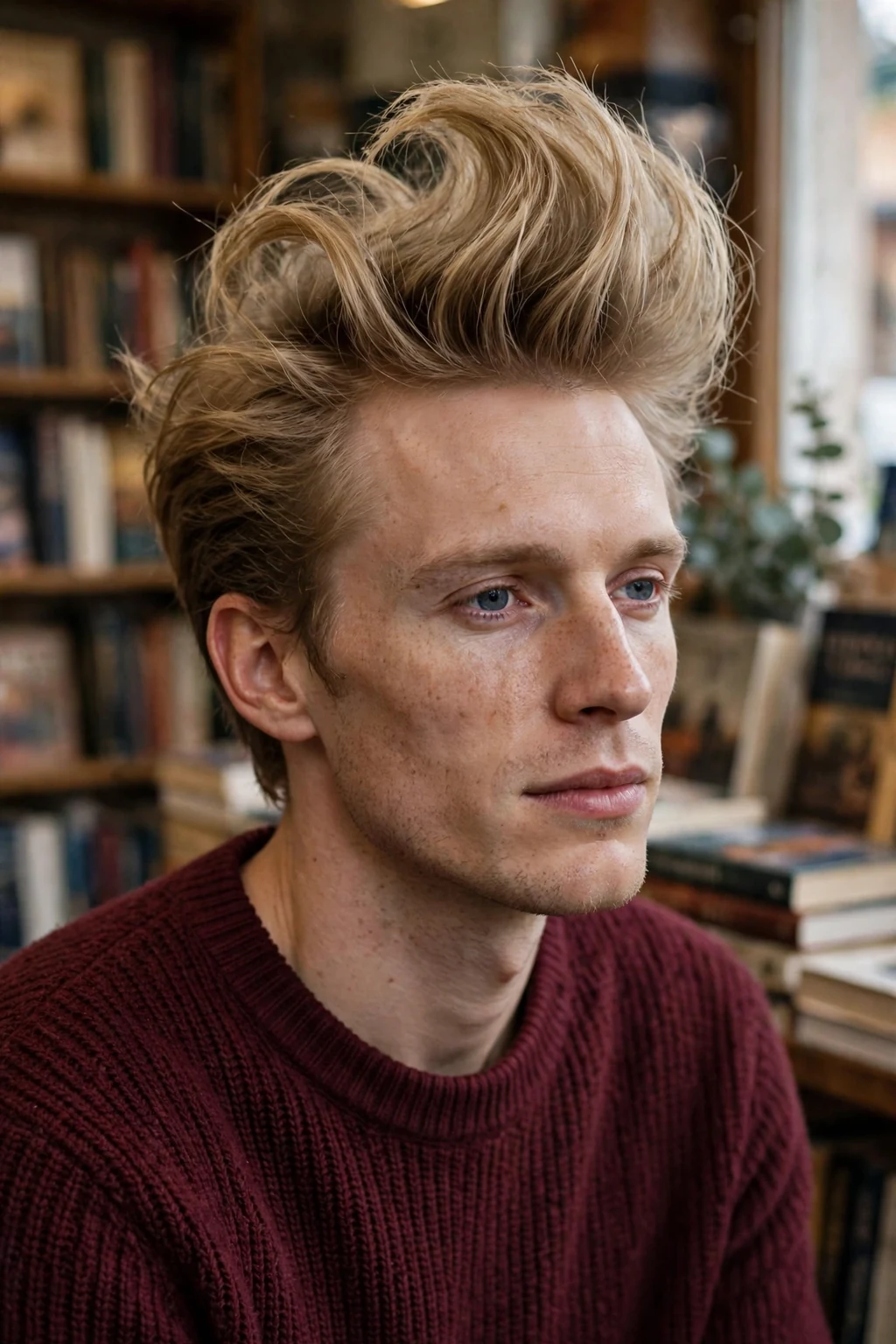
The long quiff is the dramatic showpiece of the family: the top is grown out to four inches or more, swept up into a tall, flowing wave that dominates the whole haircut. Its appearance is bold and romantic, with sweeping lines, visible movement, and a front that can be styled high and proud or swept to one side for a softer effect. Longer length gives you more styling options than any other quiff, from a towering rockabilly shape to a loose, windswept wave, and it makes a strong statement wherever you wear it. The extra length also allows for creative variation, including a deep side sweep, a centre wave, or a loose, windswept finish that changes with the weather and your mood. From the back, the longer top blends into a fuller crown, giving the whole head a balanced, proportionate shape rather than a top-heavy look. It suits creative and fashion-conscious men particularly well, because the length itself becomes a visible expression of personal style.
Long quiffs suit oval and oblong faces best, since the extra height lengthens the face, and they need medium to thick straight or wavy hair to hold the shape without collapsing. Very fine hair may struggle with the weight, so ask your barber about layering for support. To style, apply volumising mousse to damp hair, blow-dry the front up and back in sections with a round brush, and lock it in with a strong-hold pomade or a light spray. A trim every five to six weeks keeps the ends healthy while preserving length. Choose the long quiff when you want drama, versatility, and a style people remember. Long quiffs need a little more patience in the morning, so set aside five to ten minutes for blow-drying in sections rather than rushing the whole top at once. A heat protectant spray is worth using, since regular blow-drying of longer hair can cause dryness and split ends over time. Sleep on a silk or satin pillowcase if you want to reduce morning frizz, and use a wide-tooth comb rather than a fine comb to avoid breaking the longer strands.
6. Messy Quiff
The messy quiff is the deliberately undone version: the front is lifted and pushed in different directions so it looks like you have just run your hands through it, with texture and separation everywhere. Its appearance is casual and youthful, with a lived-in finish, soft edges, and no obvious parting or comb lines. The charm lies in its imperfection, because the controlled mess makes the cut look natural and effortless, as if great hair just happens to you, even though a few minutes of styling went into it. The tousled finish also hides minor imperfections, such as uneven growth or a cowlick, because the eye reads the whole top as intentionally irregular rather than searching for a flaw. In photographs it looks relaxed and approachable, which is why it is popular for casual portraits and social occasions. You can dial the mess up for weekends or tame it slightly with a comb for smarter settings, so one cut covers a wide range of moods.
Messy quiffs suit oval, round, and square faces and work brilliantly on wavy and thick hair, where natural texture does half the work. Straight hair can achieve the look too, with the help of sea salt spray and matte paste. To style, spray sea salt spray onto damp hair, blow-dry roughly with your fingers while lifting the front, then work paste through and twist random pieces in different directions. A trim every four weeks keeps the mess looking intentional. Choose the messy quiff when you want a relaxed, approachable style that never looks overdone. To keep the mess looking deliberate, focus the product on the mid-lengths and ends rather than the roots, where too much paste can make hair look flat and dirty. Let the hair air-dry halfway before blow-drying if you have time, because this encourages natural texture to form. Refresh the style during the day by simply scrunching the front with dry hands, which reactivates the paste without needing to reapply product.

7. Sleek Quiff
The sleek quiff is the polished, boardroom-ready version: every strand is smoothed into place, the front forms a clean, glossy wave, and the sides lie flat and neat against the head. Its appearance is refined and expensive-looking, with a subtle shine, a precise silhouette, and a finish that suggests careful grooming rather than casual effort. It pairs beautifully with a suit, a smart shirt, or formal occasion wear, and it photographs with a clean, confident profile that never looks messy or uncertain. The glossy surface reflects light evenly, which makes the hair look healthy and well-conditioned even under harsh office lighting or camera flashes. Sideburns and the neckline are kept crisp, reinforcing the tailored impression and ensuring the cut complements a collar and tie rather than competing with them. It is also a reliable choice for photographs and formal portraits, where a clean silhouette always reads as confident and composed.
Sleek quiffs suit oval, square, and diamond faces and work best on straight hair of medium thickness, which smooths easily and holds a comb line. Wavy hair can be sleeked too, but it needs a stronger smoothing product and a careful blow-dry. To style, apply a smoothing cream and a medium-shine pomade to damp hair, blow-dry the top back with a flat brush, then comb the front into its wave and finish with a light shine spray. A trim every three to four weeks keeps the outline crisp. Choose the sleek quiff when you want elegance, authority, and a finish that stays perfect all day. Use a comb with fine teeth for the final shaping, because fingers alone cannot achieve the smooth, even surface this style requires. Start with less pomade than you think you need and add more only if the hair still feels unruly, since excess shine quickly tips from polished into greasy. A weekly deep-conditioning treatment helps maintain the healthy gloss, especially if you blow-dry daily or use heat tools regularly.

8. Side-Swept Quiff
The side-swept quiff softens the classic shape by sweeping the front diagonally across the forehead instead of straight back, creating an elegant asymmetric line. Its appearance is gentle and flattering, with a diagonal sweep that breaks up the forehead, adds movement across the face, and gives the cut a relaxed, romantic feel. The sweep also makes the style more forgiving as it grows out, because longer pieces simply fall further across rather than losing their shape, which is a practical bonus. The diagonal sweep also creates a flattering frame for glasses, since the hairline moves across the forehead in a line that complements most frame shapes. When viewed in profile, the sweep gives the cut a graceful, flowing outline that looks softer than a straight-back quiff. It is a particularly good choice for men who find a high, upright front too dramatic, because the sweep keeps the height while making it feel more understated.
Side-swept quiffs are especially flattering for round and square faces, since the diagonal line slims and balances the features, and they suit straight and wavy hair of medium density. Men with a strong cowlick should tell their barber, so the sweep can be cut to work with it rather than against it. To style, apply light-hold cream to damp hair, blow-dry the front up and across with a round brush, and guide it into place with a comb or your fingers. A trim every four to five weeks maintains the sweep length. Choose the side-swept quiff when you want a softer, more romantic take on a bold cut. If your hair naturally falls to one side, work with that direction rather than forcing the sweep the other way, because fighting your growth pattern will cause the style to collapse by midday. A round brush is the most useful tool here, as it lets you roll the front up and across in one smooth motion. Finish with a flexible spray rather than a stiff one, so the sweep keeps its soft movement instead of freezing into a helmet.

9. Undercut Quiff
The undercut quiff is built on bold contrast: the top is left long and lifted into a full quiff, while the sides and back are clipped short or shaved, with a sharp line where the two lengths meet. Its appearance is striking and edgy, with a dramatic difference between the voluminous top and the tight sides, and a silhouette that looks modern and rebellious from every angle. The contrast also makes the quiff itself look taller and fuller, because there is nothing competing with it at the sides. The sharp contrast also means the cut is very photogenic, with a clear graphic shape that stands out in profile pictures and on stage. It pairs well with tattoos, earrings, and bold clothing, because the haircut itself already carries a strong visual identity. You can also vary the top dramatically, from a neat sweep to a wild textured peak, while the short sides keep the overall look grounded and tidy.
Undercut quiffs suit oval, square, and oblong faces and work on straight, wavy, and thick hair that can hold height on top. They are less forgiving on very fine hair, where the top may look thin against bare sides. To style, apply strong-hold clay to damp hair, blow-dry the top up and back, and keep the sides neat with a weekly tidy-up or a barber visit. A trim every two to three weeks keeps the undercut sharp, since regrowth shows quickly. Choose the undercut quiff when you want maximum contrast and a confident, statement-making cut. Ask your barber whether a high, mid, or low undercut suits your head shape, because the height of the disconnect changes the whole balance of the cut. Keep a pair of clippers at home only if you are confident maintaining the line, otherwise book short tidy-up appointments between full cuts. Strong-hold products are essential here, because a floppy top against bare sides looks unfinished rather than edgy.

10. Taper Fade Quiff
The taper fade quiff combines the classic lifted front with a gradual taper that fades the sides neatly into the skin at the neckline and around the ears. Its appearance is clean and contemporary, with a smooth gradient at the sides, a well-defined top, and an overall shape that looks sharp without being extreme. The taper keeps the cut looking fresh for longer than a blunt side, and it gives the quiff a professional edge that works in almost any setting, from the gym to a wedding. The gradual fade also flatters the natural shape of the head, following its curves instead of cutting across them, which is why it looks good on so many different men. It transitions smoothly into a beard or clean-shaven jaw, and it never looks as stark as a skin fade, making it suitable for conservative workplaces. As it grows out, the fade simply becomes a taper, so you have a longer window before it starts to look untidy.
Taper fade quiffs suit nearly every face shape, especially oval and square faces, and they work on straight, wavy, and curly hair, since the fade is about the sides rather than the top texture. To style, apply matte paste to damp hair, blow-dry the front upward, and shape the top with your fingers for a natural finish. A trim every two to three weeks keeps the fade crisp, because even a little regrowth softens the gradient. Choose the taper fade quiff when you want a modern, low-drama cut that always looks freshly barbered. When booking, specify whether you want a low, mid, or high taper, and show your barber a photo of the exact gradient you like, because taper is a broad term. Use a matte product to keep the top looking natural against the clean sides, and avoid heavy shine that can make the contrast look dated. A quick neckline tidy-up at home with a trimmer can extend the life of the fade by several days.

11. Skin Fade Quiff
The skin fade quiff takes the taper to its boldest extreme, fading the sides right down to bare skin so the lifted top stands out in dramatic relief. Its appearance is sharp, graphic, and unmistakably modern, with a clean bald gradient, a crisp line where the fade meets the longer top, and a front that looks taller and more sculpted by comparison. It is a high-impact cut that draws attention immediately, and it pairs naturally with a short beard or clean-shaven jaw for a fully groomed look. The bald gradient also highlights the bone structure of the face, drawing attention to the cheekbones and jawline in a way softer sides cannot. It looks especially sharp with a defined hairline, whether natural or carefully lined up by the barber, and it gives the whole head a sculpted, architectural quality. In summer, the short sides feel cooler and lighter, which is a practical benefit as well as a stylistic one.
Skin fade quiffs suit oval, square, and diamond faces and work best on straight or wavy hair of medium to thick density that can hold real height. The fade itself needs frequent upkeep, so be honest about your barber budget before committing. To style, use strong-hold clay on damp hair, blow-dry the top up and back, and finish with a matte product for definition. A trim every one to two weeks keeps the skin fade truly sharp. Choose the skin fade quiff when you want the boldest, cleanest version of the style. Be prepared for the upkeep commitment, because a skin fade loses its crispness faster than any other fade and needs a barber every week or two to stay truly bald at the bottom. Between visits, you can clean up the neckline with a trimmer, but leave the gradient itself to a professional to avoid uneven patches. A matte, strong-hold product is best for the top, since shine can make the contrast look less modern.

12. Curly Quiff
The curly quiff proves curls and height belong together: the top is left long enough for curls to form, then lifted and shaped forward and up so the natural curl becomes the star of the cut. Its appearance is full, lively, and full of character, with defined curls at the front, texture in every direction, and a silhouette that is softer and more organic than a straight quiff. No two curly quiffs look alike, because the curl pattern itself gives each one a unique shape and movement. Because curls shrink as they dry, the cut should leave extra length at the front, so the finished quiff still has height once the curls have settled. The sides can be tapered or faded to keep the focus on the curls, and the overall shape should be rounded rather than boxy, which flatters the face. It is a style that celebrates individuality, since no two heads of curls behave exactly the same way.
Curly quiffs suit oval, round, and heart-shaped faces and, naturally, men with wavy to tightly curly hair; straight hair cannot fake this texture convincingly. The key is a cut that respects the curl pattern, usually cut dry or with curls in their natural state. To style, apply curl cream to soaking wet hair, scrunch the front upward, and diffuse on low heat or air-dry, then pick out the roots gently for height. A trim every six to eight weeks keeps the shape balanced. Choose the curly quiff when you want to celebrate your natural texture instead of fighting it. Never brush curly hair when it is dry, because that breaks the curl pattern and creates frizz instead of definition. Use a leave-in conditioner to keep curls hydrated, and sleep on a satin pillowcase to reduce overnight frizz and tangling. If your curls lose definition during the day, a light mist of water mixed with curl cream revives them without a full restyle, making this cut more practical than it first appears.

13. Wavy Quiff
The wavy quiff uses natural wave as its main styling feature: the front is lifted into a soft, rolling wave rather than a stiff peak, giving the cut a relaxed, beachy elegance. Its appearance is fluid and touchable, with gentle bends through the top, a front that moves naturally, and a finish that looks effortlessly good even after a long day. Waves add built-in volume and texture, so this version often needs less product and less blow-drying than a straight quiff to look full and intentional. Waves also catch light beautifully, creating natural highlights and shadows through the top without any colouring. The style looks good slightly grown out, because longer waves simply become more pronounced and romantic, rather than losing their shape. It is a versatile cut for men who spend time outdoors, since wind and movement only enhance the wavy texture instead of ruining a precise shape. This natural movement is what makes the style so appealing in everyday life.
Wavy quiffs suit oval, oblong, and heart-shaped faces and are ideal for men with naturally wavy hair of medium thickness. Straight hair can be coaxed into waves with a diffuser and sea salt spray, but the result will be softer. To style, apply sea salt spray and light cream to damp hair, blow-dry the front upward while scrunching, and let the waves settle naturally. A trim every four to five weeks keeps the wave pattern tidy. Choose the wavy quiff when you want a softer, more natural version with movement built in. To encourage waves, avoid brushing the hair straight while blow-drying, and instead scrunch and twist sections as you dry them. A diffuser attachment spreads the airflow and protects the wave pattern, while direct high heat can flatten it. On days when you skip washing, a sea salt spray refreshes the waves and adds grip, so you can restyle the front in under a minute.

14. Pompadour Quiff
The pompadour quiff blends two icons into one dramatic style: the tall, rounded bulk of a pompadour at the front, with the swept-back direction and tapered sides of a quiff. Its appearance is grand and vintage-inspired, with serious height, a smooth rounded profile, and a finish that looks deliberately sculpted. It is the most formal and theatrical quiff on this list, and it carries a retro confidence that suits weddings, performances, and any occasion where you want to be remembered. The rounded front also creates a strong profile that looks impressive from the side, which is why the pompadour has always been associated with performers and style icons. It can be worn with a glossy finish for a true vintage look or a matte finish for a more modern interpretation, and the height can be adjusted to suit the occasion. Despite its drama, the shape is surprisingly balanced, because the tapered sides keep the volume focused at the front.
Pompadour quiffs suit oval and oblong faces best, since the height elongates the face further, and they need thick straight or wavy hair to support the volume without collapsing. Fine hair will need volumising mousse, a round brush, and strong hold. To style, apply mousse to damp hair, blow-dry the front up and back in sections, backcomb the roots lightly for support, and smooth the surface with pomade. A trim every four weeks maintains the shape. Choose the pompadour quiff when you want vintage glamour with modern precision. Building a pompadour takes practice, so watch a tutorial or ask your barber to demonstrate the blow-drying technique before your first attempt at home. Backcombing should be gentle, using a fine comb and only at the roots, to avoid damaging the hair over time. Remove backcombing carefully at night with conditioner and a wide-tooth comb, and give your hair a rest day each week if you style it this tall regularly.

15. Disconnected Quiff
The disconnected quiff removes the blend entirely: a sharp, visible line separates the long lifted top from the short sides, creating a bold, graphic haircut with no gradual transition. Its appearance is edgy and fashion-forward, with a hard edge that frames the top, a top that looks deliberately placed rather than blended, and a silhouette that stands out in a crowd. The disconnection gives the style a runway feel, and it works especially well when the top is styled with texture or a slight sweep. The hard edge also makes the cut easy to describe to a new barber, since the disconnect itself is unmistakable and photographs clearly. It works well with coloured or highlighted tops, because the sharp boundary frames the colour like a picture frame. The style can be softened by styling the top forward over the line or sharpened by combing it back, giving you control over how bold it reads on any given day.
Disconnected quiffs suit oval, square, and diamond faces and work on straight and wavy hair of medium to thick density. They demand confidence and regular upkeep, because the sharp line is the whole point and it softens quickly as hair grows. To style, use matte clay on damp hair, blow-dry the top up and back, and define the part line with a comb if you want extra sharpness. A trim every two weeks keeps the disconnect crisp. Choose the disconnected quiff when you want a bold, editorial cut that makes no apologies. Grow-out is the main challenge, because the sides quickly blur the sharp line and the cut can start to look like an ordinary tapered style within two weeks. Book regular appointments and do not try to maintain the line yourself unless you are experienced with clippers and a steady hand. A strong matte product keeps the top in place and prevents it from flopping over the disconnect, which would hide the very feature that defines the cut.

16. Quiff with Hard Part
The quiff with a hard part adds a precise, shaved line that runs back from the forehead, dividing the lifted top from the shorter side with razor-sharp definition. Its appearance is ultra-groomed and architectural, with a clean white line that catches the eye, a top that sweeps away from the part, and sides that look freshly clipped. The hard part gives an otherwise familiar quiff a custom, barbershop-crafted feel, and it is a simple way to make a classic cut look newly intentional. The line also serves as a useful styling guide each morning, showing you exactly where to part the hair and which direction to sweep the top. It adds a vintage barbershop character that suits tailored clothing and classic accessories, from watches to leather shoes. Even a relatively simple quiff looks custom and considered once a hard part is added, which is why barbers often suggest it as an easy upgrade.
This version suits oval, square, and round faces and works on straight and wavy hair of medium density; the part placement can be adjusted to balance a high forehead or a strong jaw. It is not ideal if you dislike frequent barber visits, because the shaved line grows out in about a week. To style, apply pomade to damp hair, blow-dry the top away from the part, and comb the side down neatly, refreshing the line with a trimmer if your barber shows you how. A trim every one to two weeks keeps it razor sharp. Choose this quiff when you love precision and detail. If the line starts to blur, resist the urge to re-shave it freehand without a guide, because a wobbly line is worse than a soft one. Instead, use a comb to keep the part clean and book a quick barber tidy-up, which usually takes only a few minutes. Protect the shaved line from sunburn in summer with sunscreen or a hat, since freshly shaved skin is more sensitive than the surrounding scalp.

17. Slicked-Back Quiff
The slicked-back quiff keeps the signature lift at the forehead but brushes everything behind it smoothly back, creating a streamlined, confident profile with no stray pieces. Its appearance is smooth and controlled, with a gentle rise at the front, a flat, tidy crown, and a finish that can range from matte to lightly glossy depending on product. It is a grown-up, versatile quiff that works for formal events, creative offices, and evenings out, and it stays put better than more textured versions in wind and humidity. The streamlined shape also works well under hats and helmets, because there are no tall, textured pieces to be crushed out of shape. After removing a hat, a quick finger-comb usually restores the lift at the front, making this a practical choice for cyclists and motorcyclists. It also photographs cleanly from every angle, with no stray strands to distract from the overall silhouette. The result is a confident, streamlined look that suits many occasions.
Slicked-back quiffs suit oval, square, and oblong faces and work best on straight to wavy hair of medium to thick density; very curly hair will need straightening to achieve the smooth effect. To style, apply pomade or cream to damp hair, blow-dry everything back with a flat brush while lifting the front, then comb back and set with a light spray. A trim every four weeks keeps the back from getting bulky. Choose the slicked-back quiff when you want a tidy, confident style with lasting hold. For a matte version, choose a clay or paste instead of pomade, and apply it to almost-dry hair so the product distributes evenly. If you prefer shine, add a single drop of grooming oil over the pomade, but avoid layering too many shiny products or the hair will look wet rather than groomed. Wash out pomade thoroughly with a clarifying shampoo once a week to prevent build-up on the scalp.

18. Voluminous Quiff
The voluminous quiff goes all in on height and fullness: the top is cut and styled to look as big as possible, with airy lift at the roots, a tall front, and a rounded, cloud-like silhouette. Its appearance is bold and glamorous, with maximum presence, soft fullness through the crown, and a finish that looks deliberately abundant rather than flat or weighed down. It is the quiff for men who love big hair and are happy to spend a few extra minutes achieving it, because the payoff is a head-turning shape. The airy volume also makes the face look more balanced, because the height on top draws the eye upward and lengthens the overall impression. It photographs with a soft, glamorous quality, and it pairs well with statement clothing, since the hair itself is already a bold accessory. Despite its size, the style can still look natural if the edges are kept soft rather than sprayed into a rigid shape.
Voluminous quiffs suit oval, oblong, and heart-shaped faces and need medium to thick hair to sustain the height; fine hair can work with volumising mousse, root powder, and careful backcombing, but it needs more support. To style, apply mousse to damp roots, blow-dry upward in sections with a round brush, dust root powder at the crown, and finish with flexible spray that allows movement. A trim every four weeks prevents weight from dragging the volume down. Choose the voluminous quiff when you want your hair to be the first thing people notice. To build volume that lasts, dry the hair in the opposite direction to how it will fall, then flip it into place once the roots are set. Root-lifting spray applied before blow-drying is more effective than adding extra product afterwards, which only weighs the hair down. Avoid touching the top too often during the day, because hands transfer oil that collapses volume faster than humidity or wind.

19. Quiff and Beard Combo
The quiff and beard combo balances a lifted, groomed top with a full, well-shaped beard, creating a complete look that frames the whole face from hairline to jaw. Its appearance is rugged yet refined, with height on top, structure at the sides, and a beard that adds weight and masculinity to the lower face. When both elements are shaped to complement each other, the result looks intentional and handsome rather than accidental, and it suits men who want a strong, mature presence. The combination also photographs well, because the vertical lines of the quiff and the beard frame the face on both sides, creating a balanced composition. It suits a wide range of personal styles, from rugged outdoor clothing to smart casual shirts, because the grooming itself does the talking. When both hair and beard are well maintained, the overall impression is one of a man who takes pride in his appearance without being vain about it.
This combination suits oval, round, and heart-shaped faces especially well, since the beard adds definition to a softer jawline, and it works with straight, wavy, and curly hair on top. Beard care matters as much as hair care here, so plan for both. To style the quiff, use matte clay and a quick blow-dry upward; for the beard, apply beard oil daily, comb it into shape, and trim the neckline and cheek lines weekly. A barber visit every three to four weeks keeps hair and beard in proportion. Choose this combo when you want a complete, masculine grooming statement. Keep the proportions in mind, because a very tall quiff with a very long beard can overwhelm a smaller face, so adjust one element if the other grows longer. Trim the beard with the same frequency as the haircut to keep the two in harmony, and use a beard brush to train the hairs into shape. A barber who shapes both hair and beard in one appointment will achieve a better overall balance than treating them separately.

20. Low Fade Quiff
The low fade quiff keeps the fade subtle and low, starting just above the ears so the sides stay relatively full while the neckline and edges look clean. Its appearance is understated and professional, with a gentle gradient, a tidy outline, and a lifted top that remains the clear focal point. Because the fade is low, grow-out is far less obvious than with a high or skin fade, making this the most forgiving faded quiff for men who cannot visit the barber every week. The low fade also works beautifully with glasses and facial hair, because it leaves enough side hair to frame the ears naturally while still looking clean. It is a discreet fade that colleagues and family may notice only as a general smartness, rather than as a dramatic new haircut, which suits men who prefer subtle change. The style also transitions well between seasons, looking neat under a winter hat and fresh in summer heat.
Low fade quiffs suit every face shape, including round faces that benefit from the extra height on top, and they work on straight, wavy, and thick hair. They are also a good first fade for men trying a faded cut for the first time. To style, apply light paste to damp hair, blow-dry the front up and back, and shape with your fingers for a natural finish. A trim every three to four weeks keeps the low fade tidy without demanding weekly visits. Choose the low fade quiff when you want a clean, modern cut with easy upkeep. Because the fade is low, you can stretch appointments a little longer than with higher fades, but do not wait so long that the neckline becomes shaggy and the shape loses definition. A matte paste with medium hold is ideal, since it keeps the top natural without competing with the clean sides. If you wear a hat regularly, choose a slightly shorter top so the quiff is not flattened every time you take the hat off.

21. High Fade Quiff
The high fade quiff starts the fade high on the sides, near the temples, so most of the side hair disappears into a sharp gradient and the long top takes centre stage. Its appearance is bold and athletic, with a strong contrast, a clean upper side profile, and a top that looks even taller against the short sides. The high fade gives the cut a sporty, modern energy, and it is a favourite for men who want a sharp look that still leaves plenty of styling freedom on top. The high fade also keeps the head feeling cool and light, which athletes appreciate during training and matches. It creates a strong, graphic outline that looks sharp in photographs and on video, because the contrast between skin and hair is so clear. The style can be dressed up with a suit or dressed down with sportswear, and the top can be restyled from neat to messy without changing the fade at all.
High fade quiffs suit oval, square, and diamond faces and work on straight, wavy, and curly hair, since the top can be styled in many ways. They are less flattering on very round faces if the top is kept too short, so keep some height. To style, use strong-hold matte clay on damp hair, blow-dry the top upward, and define the front with your fingers. A trim every two weeks keeps the high fade sharp, as regrowth is visible quickly. Choose the high fade quiff when you want a bold, athletic cut with a clean finish. High fades show regrowth quickly, so schedule appointments in advance if your barber books up, and do not leave it more than two weeks if you want the gradient to stay crisp. A strong-hold product is important, because a tall top needs support against short sides, and a matte finish keeps the look modern. Clean up stray hairs at the neckline between visits, but leave the fade blending to your barber.

22. Quiff for Thick Hair
A quiff for thick hair is cut to manage density rather than fight it: the interior is thinned and layered so the top can lift without becoming a heavy, unmovable block. Its appearance is full and powerful, with a tall, well-supported front, texture that prevents bulk, and a shape that holds all day because thick hair naturally supports height. Thick hair is actually the ideal quiff hair, provided the cut removes enough weight, because it gives you volume, hold, and staying power with minimal product. Thick hair also holds a quiff through humidity and wind better than fine hair, because the density itself provides structure and resistance. The cut can be adapted to different lengths, from a short, punchy quiff to a tall, dramatic wave, without losing its shape. It also ages well between appointments, since thick hair grows into a fuller version of the same style rather than becoming shapeless.
This version suits oval, square, and oblong faces and, by definition, men with thick straight, wavy, or curly hair. The main risk is bulk at the sides, so ask your barber to taper them closely and thin the crown area. To style, apply a small amount of strong-hold clay to damp hair, since thick hair needs less product than you think, blow-dry the front up and back, and finish with a matte paste. A trim every four weeks removes regrowing bulk. Choose this quiff when your thick hair needs a cut designed around its natural strength. Thinning should be done carefully and evenly, because removing too much from one area can create visible gaps or a patchy appearance when the hair moves. Ask your barber to use thinning shears sparingly and to check the result while the hair is dry, since wet thick hair looks deceptively heavy. A lightweight clay gives hold without adding bulk, and washing with a volumising shampoo helps keep thick hair from feeling weighed down.

23. Quiff for Fine Hair
A quiff for fine hair is engineered for lightness: the front is kept shorter, the top is layered for support, and styling focuses on root lift rather than weighty products that would flatten it. Its appearance is airy and surprisingly full, with a lifted front that creates the illusion of thickness, fine strands grouped into a neat shape, and a finish that looks fuller than the hair actually is. With the right cut, fine hair can absolutely wear a quiff, and it often looks sharper than heavier versions because the shape stays clean. The shorter front also means the style is quick to dry and style, which is a practical advantage on busy mornings. It can be combined with a subtle fade or taper to add structure, and the overall effect is clean and youthful rather than thin or sparse. Many men are surprised by how full a well-cut fine-hair quiff looks, because the lift and layering create an optical illusion of density.
This version suits oval, round, and heart-shaped faces and men with fine or thinning straight hair; it also helps men with early thinning, since lift at the front draws the eye upward. Avoid heavy pomades and oils, which collapse fine hair. To style, apply volumising mousse and root powder to damp hair, blow-dry the front upward against the direction of growth, and set with a light matte paste. A trim every three to four weeks keeps the shape supportive. Choose this quiff when fine hair has made you think a quiff was out of reach. Root powder is your best friend for fine hair, as a tiny dusting at the crown adds grip and volume that paste alone cannot achieve. Apply products to damp, not soaking wet, hair, and blow-dry with a small round brush for maximum lift at the front. Avoid conditioner on the roots, which can flatten fine hair, and instead condition only the mid-lengths and ends to keep the hair healthy without sacrificing volume.

24. Asymmetrical Quiff
The asymmetrical quiff deliberately breaks symmetry: one side of the front is left longer and swept across, while the other side is shorter and tighter, creating a dynamic, off-centre shape. Its appearance is artistic and modern, with an uneven front line, diagonal movement, and a silhouette that looks different from the left and the right. This asymmetry gives the cut a fashion-forward edge and a sense of movement that symmetrical quiffs cannot match, making it a favourite for creative professionals and style-conscious men. The uneven shape also draws attention to the eyes, because the diagonal sweep creates a line that leads the viewer across the face. It looks particularly striking with a textured finish, where the longer pieces break into separate strands and the shorter side stays neat. The cut can be adjusted over time, with the longer side grown out further for more drama or trimmed back for a subtler effect.
Asymmetrical quiffs suit oval, square, and heart-shaped faces and work on straight and wavy hair of medium density; the longer side needs enough length to sweep convincingly. Tell your barber which side you naturally part on, so the asymmetry works with your growth pattern. To style, apply matte paste to damp hair, blow-dry the longer side up and across, keep the shorter side close, and finish by twisting the long pieces for definition. A trim every three weeks preserves the uneven lengths. Choose this quiff when you want an artistic, unconventional twist. Asymmetry requires a barber who understands balance, so look for someone experienced with creative cuts rather than a quick walk-in service. Photograph the cut from both sides at your appointment, so you can show exactly how much difference you want between the two sides next time. Styling takes a little practice, because the two sides need different amounts of product and attention, but the result is worth the extra minute.

25. Vintage Quiff
The vintage quiff is a loving tribute to the original rock-and-roll era: a high, rounded wave at the front, neatly combed sides, and a glossy, sculpted finish inspired by the nineteen-fifties icons who made the style famous. Its appearance is nostalgic and dapper, with a smooth, sculpted wave, a clean side profile, and a shine that recalls pomade-era grooming. It pairs perfectly with vintage-inspired clothing, from denim jackets to tailored suits, and it carries a timeless cool that never feels like a costume when worn with confidence. The sculpted wave also gives the cut a sense of occasion, making it ideal for weddings, parties, and retro-themed events where a modern messy style might feel underdressed. It pairs naturally with classic accessories such as leather jackets, boots, and denim, but it also looks surprisingly contemporary with a simple modern outfit. The vintage quiff proves that a style from seventy years ago can still feel fresh when it is cut and styled with care.
Vintage quiffs suit oval, square, and oblong faces and work best on thick straight or wavy hair that can hold a sculpted wave; fine hair can work with strong pomade and careful backcombing. To style, apply a medium-shine pomade to damp hair, comb the top back and up into its wave, smooth the sides flat, and set with a firm spray for all-day hold. A trim every three to four weeks keeps the retro silhouette precise. Choose the vintage quiff when you want classic rock-and-roll charm with a polished, timeless finish. Vintage styling rewards patience, so allow extra time on your first few attempts until the combing and pomade routine becomes second nature. A boar-bristle brush helps smooth the surface without flattening the wave, and a firm-hold spray locks the shape without making it crunchy. Wash pomade out with warm water and a good shampoo, since build-up can dull the shine and weigh the wave down over time.

26. Brushed-Up Quiff
The brushed-up quiff is the high-energy cousin of the classic quiff: the entire front section is swept straight upward and slightly back, creating a tall, airy wall of hair that looks bold from every angle. Unlike the smooth, rounded classic, this version keeps visible separation between strands, so the finish reads textured and modern rather than polished and formal. The sides are usually kept short with a taper or low fade, which makes the height on top look even more dramatic, while the back is blended neatly so the silhouette stays clean and wearable. It works best on straight to wavy hair with medium density, because the strands need enough body to stand up without collapsing, and it flatters oval, square, and heart-shaped faces by adding length and drawing the eye upward. Men with very fine hair can still wear it, but they will need a strong pre-styler and a slightly shorter front to keep the lift from falling flat by lunchtime.
To style a brushed-up quiff, work a volumising mousse or sea-salt spray through damp hair, then blow-dry the front straight upward with a vent brush, lifting at the roots until the section holds its own shape. Finish with a matte clay or strong-hold paste, pushing the hair up and back with your fingers rather than a comb so the texture stays piecey and natural. A light mist of hairspray locks the height in place without stiffness, and on humid days a small amount of styling powder at the roots adds extra grip. Book a trim every three to four weeks to keep the sides tight and the front at a workable length, since overgrown sides quickly drag the whole shape down. Try this version when you want maximum impact with a modern edge: it photographs brilliantly, suits nights out and creative workplaces, and turns an ordinary cut into a real statement.

27. Mid Fade Quiff
The mid fade quiff pairs a voluminous lifted top with a fade that starts halfway up the sides, striking a perfect balance between sharp contrast and everyday wearability. The fade blends smoothly from skin or very short hair at the midpoint into the longer top, creating a clean gradient that frames the face without the drama of a high fade. On top, the quiff itself can be worn smooth, textured, or slightly messy, so the same fade works with several different finishes depending on your mood. The look is crisp and masculine, with a tidy outline that stays smart in professional settings while still reading clearly as a modern, fashion-forward cut. It suits most face shapes, especially round and square faces, because the mid-level fade slims the sides while the height on top lengthens the overall profile. The mid fade also grows out more gracefully than a skin fade, so even a week past your appointment the cut still looks deliberate rather than overgrown, which makes it a forgiving choice for busy schedules.
Styling starts with a pre-styling cream or mousse on damp hair, blow-dried upward and back with a round brush to build root lift. A medium-hold matte paste gives control without shine, and a quick pass with a comb tidies the front into place. The fade itself is the high-maintenance part: visit the barber every two to three weeks to keep the gradient crisp, since a grown-out mid fade blurs quickly and loses its sharp edge. Between visits, keep the top conditioned so it stays soft and easy to restyle each morning. Choose the mid fade quiff if you want a cut that looks intentional from every angle, works for the office and the weekend alike, and flatters nearly every hair type from straight to wavy. If you are trying a fade for the first time, the mid fade is the safest entry point, since it delivers clear contrast without the starkness of a high fade, and your barber can easily take it higher or lower at the next visit.

28. Burst Fade Quiff
The burst fade quiff combines a lifted, textured top with a burst fade that curves around the ear in a semicircular shape, leaving the hair longer at the back of the neck. This rounded fade creates a distinctive sunburst effect that sets it apart from straight-line fades, giving the whole cut a dynamic, athletic feel. The top is usually worn with plenty of texture and forward movement, which contrasts beautifully with the clean curve of the fade, and the overall silhouette reads youthful, confident, and street-ready. It works particularly well on straight and wavy hair of medium thickness, and it flatters oval, diamond, and square faces by drawing attention to the cheekbones and jawline. Men with thick or coarse hair will find the burst fade especially flattering, since it removes bulk exactly where it tends to build up around the ears. The burst fade also works well with a short beard or stubble, since the curved fade line connects naturally to facial hair and creates a continuous, sculpted outline around the whole head.
To style it, blow-dry the top upward and slightly forward with a vent brush, then work a matte clay through the lengths to define the texture. Keep the fringe area flexible rather than stiff so the quiff moves naturally, and finish with a light hairspray if you need all-day hold. The burst fade needs barber maintenance every two to three weeks to keep its curved shape precise, and a neckline tidy between visits keeps the back looking intentional. Try the burst fade quiff when you want something more original than a standard fade: it stands out in a crowd, pairs perfectly with casual and streetwear looks, and gives a classic quiff a fresh, modern twist. Ask your barber to keep the burst tight around the ear and slightly longer toward the nape, since that gradient is what gives the fade its signature rounded shape, and bring a reference photo so the curve is exactly where you want it.

29. Drop Fade Quiff
The drop fade quiff features a fade that curves downward behind the ear, dropping lower at the back of the head to follow the natural shape of the skull. This curved fade line creates a smooth, flowing outline that looks more organic than a straight fade, and it makes the lifted top appear even more prominent by contrast. The quiff itself is usually worn with a clean, controlled finish, though a textured version works just as well for a more relaxed feel. Because the fade dips at the back, the cut looks polished from behind too, which matters if you wear your hair short at the nape or like a tidy neckline. It suits oval, oblong, and square faces, and it works on straight, wavy, and lightly curly hair, since the top length can be adjusted to suit how much natural movement your hair already has. Because the fade follows the curve of the head, the drop fade is especially flattering on men with a rounded skull shape, where a straight fade can sometimes look boxy or abrupt from behind.
Styling a drop fade quiff follows the classic routine: volumising product on damp hair, blow-dry the front up and back, and a medium-hold pomade or paste to set the shape. Use a comb for a sleek finish or your fingers for texture, and finish with hairspray on days when you need the shape to survive wind or humidity. The drop fade needs a barber visit every two to four weeks, because the curved line loses definition faster than a straight fade once it grows out. Ask your barber to show you exactly where the fade drops so you can describe it accurately at future appointments. Choose this version for a refined, contemporary quiff with a silhouette that looks considered from every single angle. The drop fade also pairs well with a beard, since the curved line can be blended into facial hair for a seamless transition, and it looks particularly sharp when the neckline is kept clean and squared off.

30. Fringe Quiff
The fringe quiff is a softer, more relaxed take on the classic style: instead of sweeping all the hair up and back, the front is lifted at the roots and then allowed to fall forward into a textured fringe across the forehead. The result keeps the height and volume of a quiff but adds a youthful, approachable edge that works brilliantly for men who find a fully swept-back style too severe. The sides are kept short with a taper or fade, which keeps the focus on the playful contrast between the lifted crown and the fringe. This version suits oval, heart-shaped, and long faces especially well, since the fringe shortens the forehead visually, and it works on straight to wavy hair with medium density. Men with a high forehead or a receding hairline often love this cut, because the fringe offers natural coverage without looking like a cover-up. The fringe quiff also works well for men growing out a shorter cut, since the fringe disguises uneven lengths at the front while the rest of the hair catches up, making the awkward in-between stage far less noticeable.
To style it, apply a light mousse to damp hair and blow-dry the roots upward, then let the front fall forward naturally, shaping the fringe with your fingers and a small amount of matte paste. Avoid heavy products that drag the fringe down or make it look greasy, and keep the texture piecey rather than perfectly combed for a modern finish. A trim every four weeks keeps the fringe at the right length and the sides tidy, and the cut grows out gracefully between visits. Try the fringe quiff if you want quiff volume with a softer, more casual character: it suits students, creatives, and anyone who prefers a relaxed look that still shows real style. For a more polished version, keep the fringe slightly shorter and neater, while a longer, messier fringe suits weekends and casual settings, so the same cut adapts easily to different parts of your life.

31. Quiff for Straight Hair
The quiff for straight hair is tailored to hair that naturally lies flat: the cut builds in layers and graduation that create lift and movement where straight hair would otherwise fall limp. Because straight strands reflect light evenly, this version often looks exceptionally sleek and polished, with a smooth surface and a clean, sharp outline that reads expensive and well-groomed. The front is kept long enough to sweep up and back, while the sides are tapered to keep the shape balanced, and the overall finish can range from glossy and formal to matte and casual depending on the product you choose. It suits oval, square, and oblong faces, and it is one of the easiest quiff variations to maintain, since straight hair responds predictably to blow-drying and holds a combed shape well. Men with fine straight hair should ask for a slightly shorter front, which lifts more easily than a long, heavy section. Straight hair also shows off the quiff's silhouette better than any other texture, with the smooth surface emphasising the height at the front and the clean taper at the sides, which is why this version photographs so well.
Styling is straightforward: a volumising mousse or root-lifting spray on damp hair, blow-dried upward with a round brush, and a medium-hold pomade combed through for a smooth finish. Straight hair takes direction well, so a single pass with the dryer usually sets the shape for the whole day, and a touch of hairspray adds insurance on windy days. Trim every four weeks to keep the graduation crisp, since straight hair shows uneven growth more obviously than textured hair. Choose this version if your hair is naturally straight and you want a quiff that works with your texture rather than fighting it: it is polished, reliable, and effortlessly smart. If your straight hair tends to fall flat by afternoon, a root-boosting spray applied before blow-drying makes a real difference, and a light styling powder can revive the lift in seconds without a full restyle. A small amount of shine spray on the finished style enhances the sleek surface without making it greasy, which is a finishing touch straight hair pulls off better than any other texture.

32. Quiff with Design Line
The quiff with a design line adds a bold graphic detail to the classic cut: a clean shaved line, or a pair of parallel lines, etched into the faded side of the head beneath the lifted top. The line acts like an underline for the quiff, drawing the eye along the fade and giving an otherwise familiar haircut an unmistakable signature. It can be subtle, a single fine line near the parting, or dramatic, with geometric shapes or curved patterns carved into a skin fade. The top itself is usually worn textured and voluminous, which contrasts sharply with the precision of the shaved detail, and the overall effect is confident, creative, and unmistakably modern. This version suits men with straight or wavy hair and works best on oval, square, and diamond faces, where the strong lines of the cut echo the angles of the face. The design can be as simple or elaborate as you like, from a single line to a geometric pattern, and because it is shaved rather than cut, it can be completely changed at your next appointment without any awkward grow-out phase.
Styling the top follows the usual quiff routine: blow-dry upward with a volumising product, then define texture with matte clay. The design line itself needs no daily care, but it does demand regular barber visits every one to two weeks, because even a few millimetres of regrowth softens the line and blurs the effect. Between visits, avoid heavy oils on the faded area, which can make regrowth look patchy. Try this quiff if you love self-expression through your haircut and want a talking point that sets you apart: it is bold without being extreme, works for nights out and creative jobs, and can be changed at every appointment. Keep in mind that a design line draws attention, so pair it with a confident attitude and a well-groomed top, and choose a barber experienced in shaved detailing, since a wobbly line is far more noticeable than a wobbly fade. A design line also photographs strikingly, so if you enjoy sharing your haircut online, this version gives you a detail that stands out in photos and gets people talking.
33. Shadow Fade Quiff
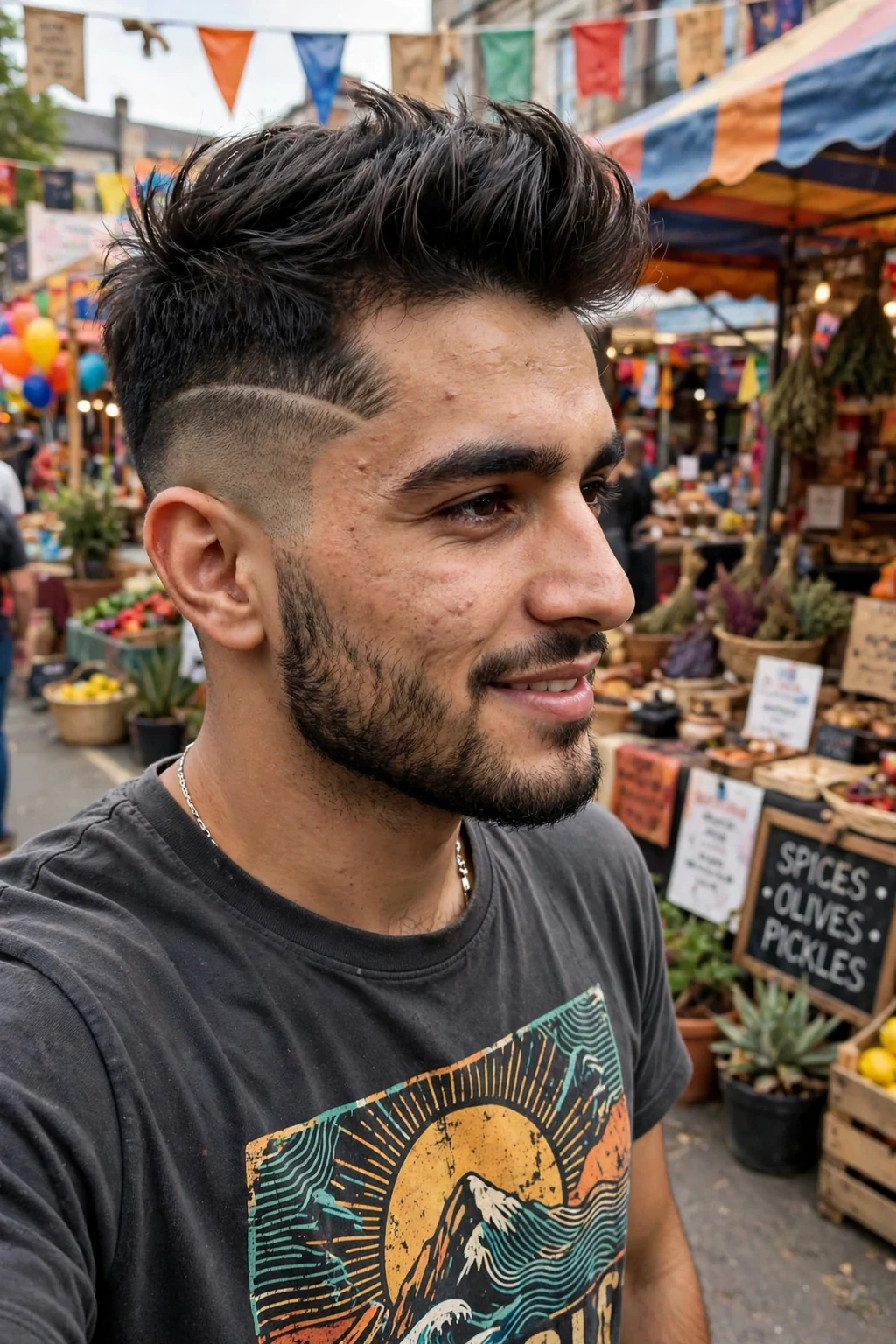
The shadow fade quiff uses a subtle, low-contrast fade that blends gradually from short to long, creating a soft shadow effect rather than a sharp skin-tight gradient. The result is a gentler, more natural-looking fade that keeps the haircut looking full and textured while still delivering the clean outline of a faded cut. On top, the quiff is worn with generous volume and a brushed-back finish, so the whole style reads refined and understated rather than aggressive. This makes it an excellent choice for men who want a modern fade but work in conservative environments, or who simply prefer a softer silhouette. It suits nearly every face shape, particularly round and oval faces, and it works beautifully on straight, wavy, and thick hair, since the gradual blend accommodates more natural bulk than a skin fade can. The shadow fade is also an excellent choice for older men or anyone returning to fades after years away, since its softness looks sophisticated rather than trendy, and it never reads as trying too hard.
To style it, blow-dry the top upward and back with a round brush and a volumising mousse, then finish with a medium-hold cream or paste for a soft, touchable hold. Avoid high-shine products, which can make the gradual fade look greasy rather than shadowy, and keep the finish matte or natural for the best effect. The shadow fade grows out more gracefully than sharper fades, so barber visits every three to four weeks are usually enough to keep it looking fresh. Choose the shadow fade quiff when you want a fade with finesse: it is modern, versatile, and smart enough for any setting. Because the blend is gradual, the shadow fade also hides regrowth well, which means you can stretch appointments to four weeks without the cut looking neglected, a practical advantage for men with busy routines. The shadow fade quiff is also easy to dress up or down, looking equally at home under a suit jacket or with a simple t-shirt, which makes it one of the most versatile quiff variations available.

34. Windswept Quiff
The windswept quiff captures the look of hair caught in a sea breeze: the top is lifted and swept diagonally to one side, with loose, flowing strands that suggest effortless movement. Unlike the structured classic quiff, this version embraces imperfection, with soft layers and a slightly uneven finish that looks natural rather than sculpted. The sides are kept medium-short with a taper, which keeps the silhouette tidy while letting the top do all the talking, and the overall effect is relaxed, romantic, and quietly confident. It works best on wavy or straight hair with medium length on top, since the strands need enough length to fall and flow, and it flatters oval, oblong, and heart-shaped faces by adding diagonal movement that softens strong features. Men with naturally wavy hair will find this is one of the easiest quiffs to wear, because the cut works with the hair's own direction. The windswept quiff is also a great holiday haircut, since it actually looks better slightly undone, and a day at the beach or a long walk in the wind only enhances the texture rather than ruining it.
Styling a windswept quiff is deliberately low-effort: apply sea-salt spray or light mousse to damp hair, rough-dry with your fingers while sweeping the top to one side, and finish with a flexible cream that holds the shape without stiffness. Resist the urge to over-comb, since the charm of this cut lies in its loose, lived-in texture, and a quick scrunch at the roots revives it through the day. Trim every four to five weeks to maintain the layered top, and let it grow slightly between visits for an even more relaxed feel. Try this version when you want a quiff that looks like you just stepped off a beach walk: it is charming, low-maintenance, and full of personality. If your hair is very straight, a light perm or a texturising cut from your barber can add the natural bend this style needs, though most wavy-haired men will find the look comes almost effortlessly.

35. Coily Quiff
The coily quiff celebrates natural texture: the top is grown out and shaped into a tall, sculpted quiff that shows off tight coils and rich volume, while the sides are faded clean for a sharp, defined outline. The silhouette is bold and architectural, with the coils forming a dense, cloud-like crown that catches the light beautifully and gives the wearer real presence. Unlike quiffs on straight hair, this version relies on the hair's natural spring and density for its height, so the finish looks organic and full rather than styled stiff. It suits oval, square, and diamond faces, and it is a fantastic choice for Black men with type 4 hair who want a modern, polished style that honours their natural texture. The contrast between the soft, voluminous top and the crisp fade is what makes this cut so striking from every angle. The coily quiff also frames the face beautifully, with the rounded top softening strong jawlines and adding height that balances broader facial features, making it flattering from the front and the side alike.
Styling starts with moisture: apply a leave-in conditioner and a curl cream to damp hair, then pick or finger-shape the top upward, defining the coils as you go. A light hold cream or butter keeps the shape soft and touchable without flaking, and a satin bonnet or durag at night protects the style and prevents frizz. Visit the barber every two to three weeks to keep the fade sharp, and get the top reshaped every four to six weeks so the coils keep their sculpted silhouette. Choose the coily quiff if you want a style that turns natural texture into a statement: it is proud, modern, and unmistakably confident. Moisture is the secret to this style, so use a good leave-in conditioner daily and avoid heavy waxes that dry coils out, and sleep on a satin pillowcase to keep the shape intact overnight. Regular deep conditioning keeps coils soft and defined, which makes the quiff easier to shape each morning and prevents the dryness that can make textured hair difficult to manage.

36. Salt-and-Pepper Quiff
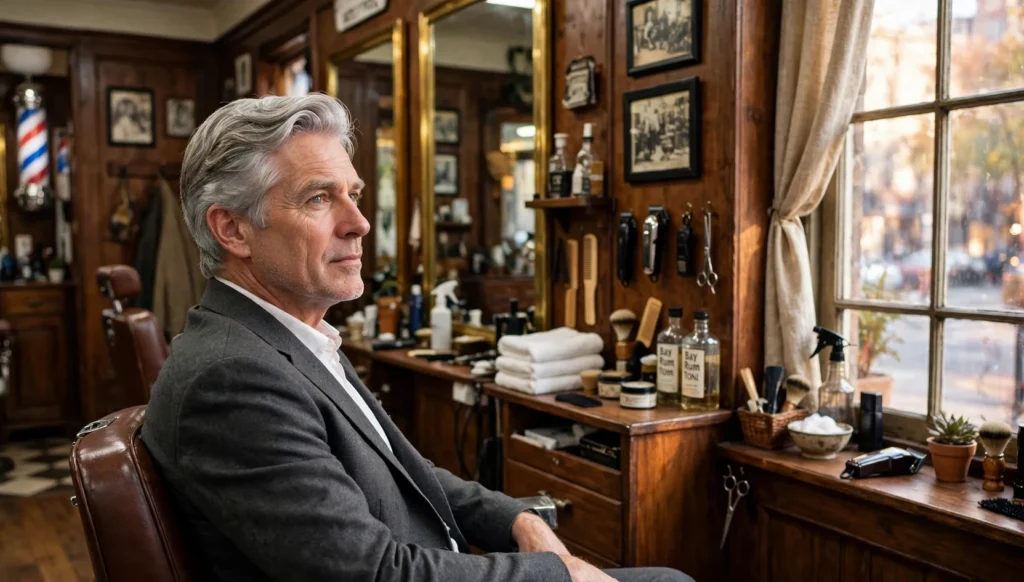
The salt-and-pepper quiff turns greying hair into the star of the show: the lifted top blends natural silver strands with the remaining darker hair, creating a dimensional, silver-flecked finish that looks distinguished rather than ageing. The quiff's height and structure give grey hair a sense of purpose and polish, while the tapered sides keep the whole cut crisp and contemporary. This version proves that a quiff is not only for young men: on mature faces it reads confident, experienced, and effortlessly stylish, especially when the silver is allowed to shine rather than being dyed away. It suits oval, square, and oblong faces, and it works on straight to wavy hair of medium thickness, with the natural coarseness that often comes with grey hair actually helping the front to hold its lift. Grey hair often has a wirier texture that holds shape well, which is a hidden advantage for the quiff, since the front stays lifted with less product than younger, softer hair usually needs.
Styling is simple but specific: use a silver-enhancing or purple-toned shampoo once a week to keep the grey bright and prevent yellowing, and blow-dry the front upward with a light volumising mousse. A matte paste or cream gives flexible hold without dulling the silver tones, and a small amount of conditioning oil keeps greying hair soft and manageable. Trim every four weeks to keep the taper tidy and the top at a flattering length. Try the salt-and-pepper quiff if you are embracing the grey: it is a style that wears experience with pride and looks better every year. The salt-and-pepper quiff also pairs beautifully with smart casual clothing, from blazers to quality knitwear, and it signals a man who is comfortable with himself and takes pride in his appearance. A good barber will also shape the sideburns and neckline to complement the silver tones, since clean edges make grey hair look intentional and well cared for rather than simply uncoloured.

37. Temple Fade Quiff
The temple fade quiff, also known as a temp fade, focuses the fade precisely on the temples and the hairline, leaving the rest of the sides slightly longer than a full fade would. This creates a sharp, clean frame around the face while preserving more hair overall, so the cut looks both edgy and full. The quiff on top is worn with plenty of volume, swept up and back, and the contrast between the tight temples and the generous top gives the style a bold, balanced silhouette. It works especially well for men with strong hairlines who want definition without committing to a high fade, and it flatters oval, square, and round faces by sharpening the edges of the face. Straight, wavy, and curly hair all suit this version, since the temple fade is about placement rather than texture. The temple fade is also a smart choice for men with thinning hair at the temples, since the tight fade minimises the contrast between thick and thin areas and makes the hairline look deliberately sharp.
To style it, blow-dry the top upward with a volumising product and set the shape with a medium-hold paste, keeping the front slightly textured for a modern feel. The temple area needs attention: the fade is small, so regrowth shows quickly, and a barber tidy every two weeks keeps the lines razor-sharp. Between visits, a clean hairline makes the whole cut look freshly done, so keep the edges neat with a gentle trimmer if you are confident doing so. Choose the temple fade quiff for a precise, face-framing version of the classic: it is sharp, versatile, and flatters almost everyone. Because only a small area is faded, the temple fade is quick for your barber to refresh, so a short tidy-up visit between full cuts keeps the whole style looking sharp with minimal time in the chair. The temple fade also works beautifully with a short, well-groomed beard, since the sharp temple lines connect visually to the beard outline and create a cohesive, sculpted look.

38. Spiky Quiff
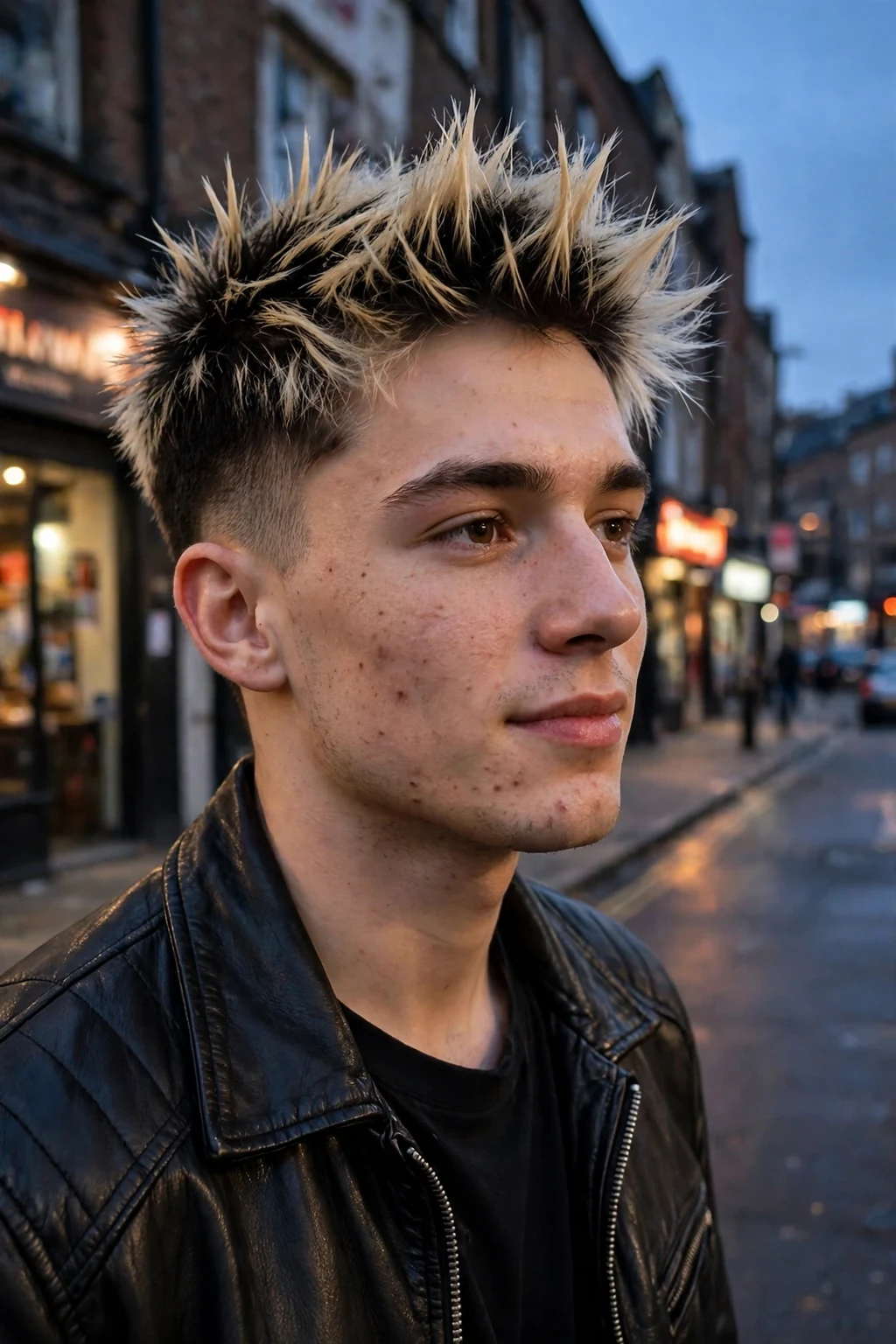
The spiky quiff fuses two iconic styles: the height and sweep of a quiff with the piecey, separated texture of spiky hair. The front is lifted high and broken into defined spikes or twisted sections, creating a bold, energetic silhouette that looks modern and a little rebellious. The sides are kept short with a fade or taper, which makes the spiky top stand out even more, while the back is blended so the cut stays clean from behind. This version suits younger men and anyone with a playful, confident style, and it flatters oval, square, and heart-shaped faces by adding height and attitude. It works best on straight to wavy hair with medium density, because the strands need enough stiffness to hold a spiked shape without collapsing. The spiky quiff also works well for nights out and festivals, where its high-energy shape stands out in a crowd, and it can be toned down for daytime simply by using less product and finger-combing the spikes softer.
Styling a spiky quiff needs a strong product: work a high-hold wax or fibre through dry or slightly damp hair, then twist and pinch sections of the front upward and slightly back to create the spikes. Blow-drying the roots upward first gives the base lift that keeps the spikes standing all day, and a firm hairspray locks the finish without making it look crunchy. Trim every three to four weeks to keep the spikes at a workable length, since overgrown tops lose their definition. Try the spiky quiff when you want a quiff with extra edge: it is fun, fearless, and guaranteed to get noticed. If your hair is very thick, ask your barber to thin the top slightly so the spikes separate cleanly rather than clumping together, which keeps the texture defined and lightweight. To refresh the spikes midday, simply dampen your hands slightly and re-pinch the sections back into shape, which revives the texture in under a minute without needing extra product.
39. Side-Part Quiff
The side-part quiff combines the structure of a classic side parting with the volume of a quiff, sweeping the lifted top diagonally across the head from a soft, natural part. The result is a refined, gentlemanly style that looks polished without feeling stiff, with the part giving the haircut a clear sense of direction and intention. Unlike a hard part, which is shaved in, this part is created simply by combing, so it can be moved or softened depending on the occasion, making the cut unusually versatile. The sides are tapered neatly, and the overall silhouette is smooth, balanced, and quietly confident. It suits oval, square, and oblong faces, and it works beautifully on straight and wavy hair, since the part helps direct hair that might otherwise fall wherever it pleases. The side-part quiff is also one of the few quiff variations that works equally well with a suit and with casual weekend clothing, since the part gives it structure while the volume keeps it from looking old-fashioned.
To style it, create the part on damp hair with a comb, then blow-dry the top upward and over, following the direction of the part, with a volumising mousse for lift. A medium-hold pomade combed through gives a smooth, polished finish, while a matte paste offers a more relaxed, contemporary feel. The part may need a quick recomb after wearing a hat, but otherwise the style holds well all day. Trim every four weeks to keep the taper neat and the part easy to find. Choose the side-part quiff when you want a quiff that works for weddings, work, and everything in between: it is timeless, adaptable, and always smart. For a modern twist, keep the part soft and slightly imperfect rather than ruler-straight, which stops the style from looking too formal and gives it a relaxed, contemporary character. The side-part quiff also ages gracefully, since the part and the volume work together to flatter mature faces just as well as younger ones, making it a cut you can keep for years.

40. Quiff for Round Faces
The quiff for round faces is designed with one goal: adding height on top while keeping the sides tight, so the face appears longer and more defined. The top is lifted as high as the hair allows, with the front swept up and slightly back to create a strong vertical line, while the sides are faded or tapered close to slim the width of the face. This combination is genuinely transformative, because the eye follows the height upward rather than settling on the roundness of the cheeks, and the overall silhouette reads oval rather than circular. The finish can be smooth or textured depending on your taste, and the cut works on straight, wavy, and thick hair, since volume on top is the key ingredient rather than any particular texture. Avoid a fringe that falls across the forehead, which shortens the face and works against the whole effect. The key is proportion, so keep the top as tall as you comfortably can and the sides as tight as possible, since every extra centimetre of height makes the face look a little longer and a little leaner.
Styling focuses on root lift: apply a volumising mousse or styling powder to damp roots, blow-dry the front straight upward with a round brush, and set the shape with a matte clay that holds without weighing the hair down. A light hairspray keeps the height in place, and on flat-hair days a quick blast of dry shampoo at the roots revives the lift instantly. Keep the sides faded every two to three weeks, since grown-out sides widen the face again and undo the slimming effect. Try this version if you have a round face and want a cut engineered to flatter it: it is confident, slimming, and effortlessly stylish. This version also works well with glasses, since the height on top balances the horizontal line of the frames, and a clean fade keeps the overall look sharp rather than heavy around the face. Keeping the top longer also gives you styling flexibility, since the same length can be worn sleek for formal occasions or textured for casual days without changing the underlying cut.
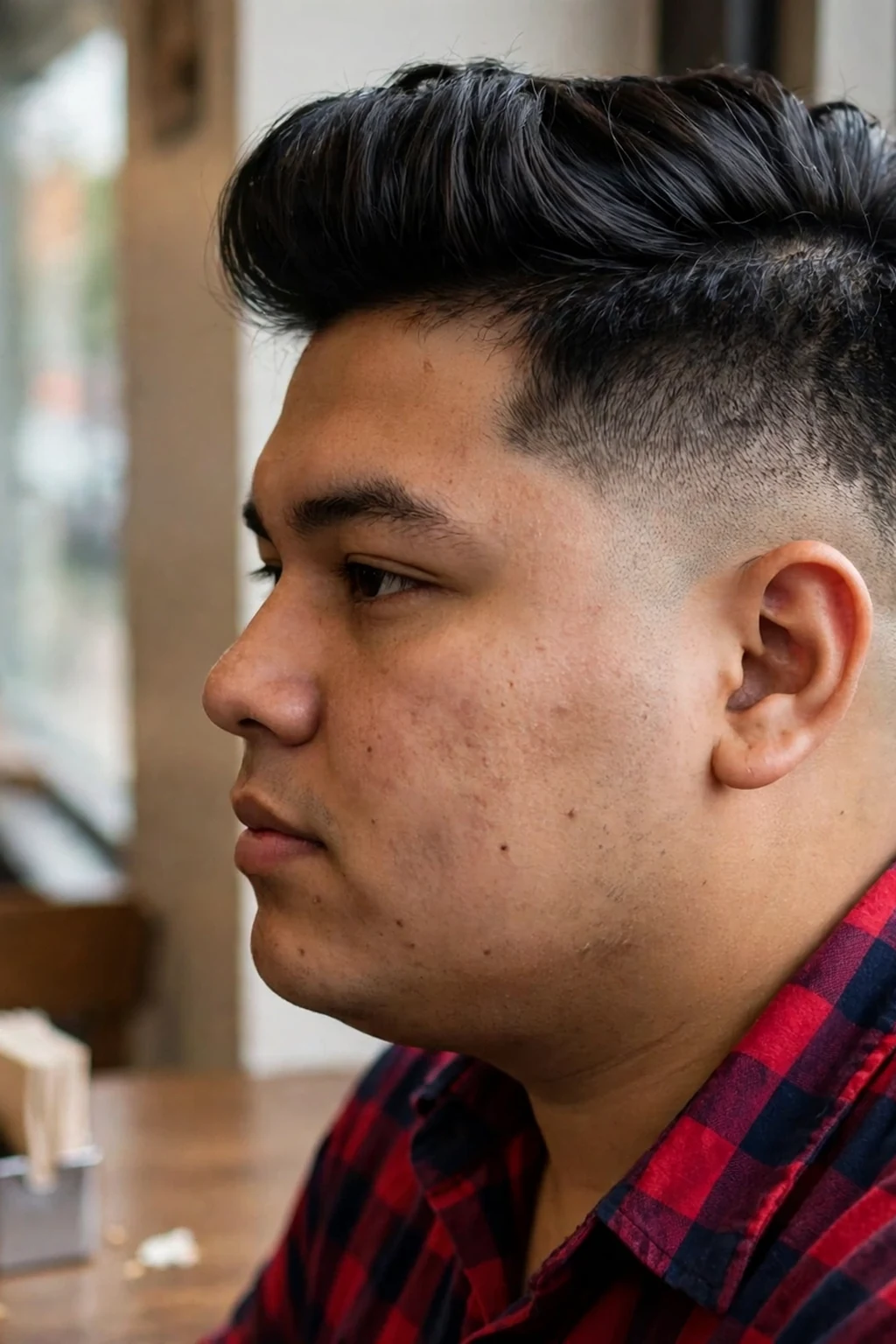
41. Feathered Quiff
The feathered quiff softens the classic cut with light, airy layers that are razored or point-cut so the ends feather outward like a bird's plumage. The top is lifted and swept back, but instead of a solid wall of hair, the finish is wispy and textured, with strands that move freely and catch the light. This gives the style a romantic, almost effortless quality that suits men who like volume without weight, and it is especially flattering on fine to medium hair, since the feathered layers create the illusion of fullness. The sides are kept tapered and neat, which balances the softness on top, and the overall silhouette is tall, light, and modern. It flatters oval, oblong, and heart-shaped faces, and it works on straight and wavy hair that can be layered without losing its shape. Feathered layers also move beautifully in the wind, giving the style a dynamic quality that solid cuts lack, and the airy texture means the quiff never looks helmet-like or over-styled.
To style a feathered quiff, blow-dry the top upward and back with a vent brush, encouraging the layers to separate, then finish with a light cream or flexible paste rather than a heavy wax, which would clump the feathering together. A texturising spray adds airy separation, and the cut should be allowed to move naturally rather than being fixed rigidly in place. Trim every four to five weeks, and ask your barber to re-feather the ends rather than blunt-cutting them, since the layered texture is the whole point of the style. Choose the feathered quiff when you want a softer, more artistic take on the classic: it is light, modern, and full of movement. If your hair is on the thicker side, ask your barber to remove weight from the top with thinning shears so the feathering stays light, and avoid heavy pomades that would collapse the layers into a solid block.

How to Choose the Right Quiff Hairstyle
The best quiff is the one that fits your hair, your face, and your daily routine. Thick hair can carry height and texture with ease, while fine hair needs lighter products and a shorter, more structured front to hold its shape. Consider how much time you want to spend styling each morning, how often you are willing to visit the barber, and whether you prefer a sharp, polished finish or a relaxed, lived-in look before you commit to a version.
A quiff rewards good habits more than expensive products. Blow-drying the front upward and back is what creates lasting lift, a matte paste or clay gives flexible hold without stiffness, and a trim every three to five weeks keeps the shape crisp as it grows. Take a photo of the exact quiff you want to your barber, describe the height and finish you prefer, and do not be afraid to adjust the length over two or three visits until the cut feels entirely your own.
Conclusion
From the timeless classic quiff to bold faded and textured versions, these 41 quiff hairstyles prove this iconic cut can suit almost every man. Choose the version that matches your hair type and lifestyle, master the blow-dry, keep up with regular trims, and wear your quiff with total confidence.